
In November 2025, a signing ceremony in Jakarta made almost no waves in Western media.
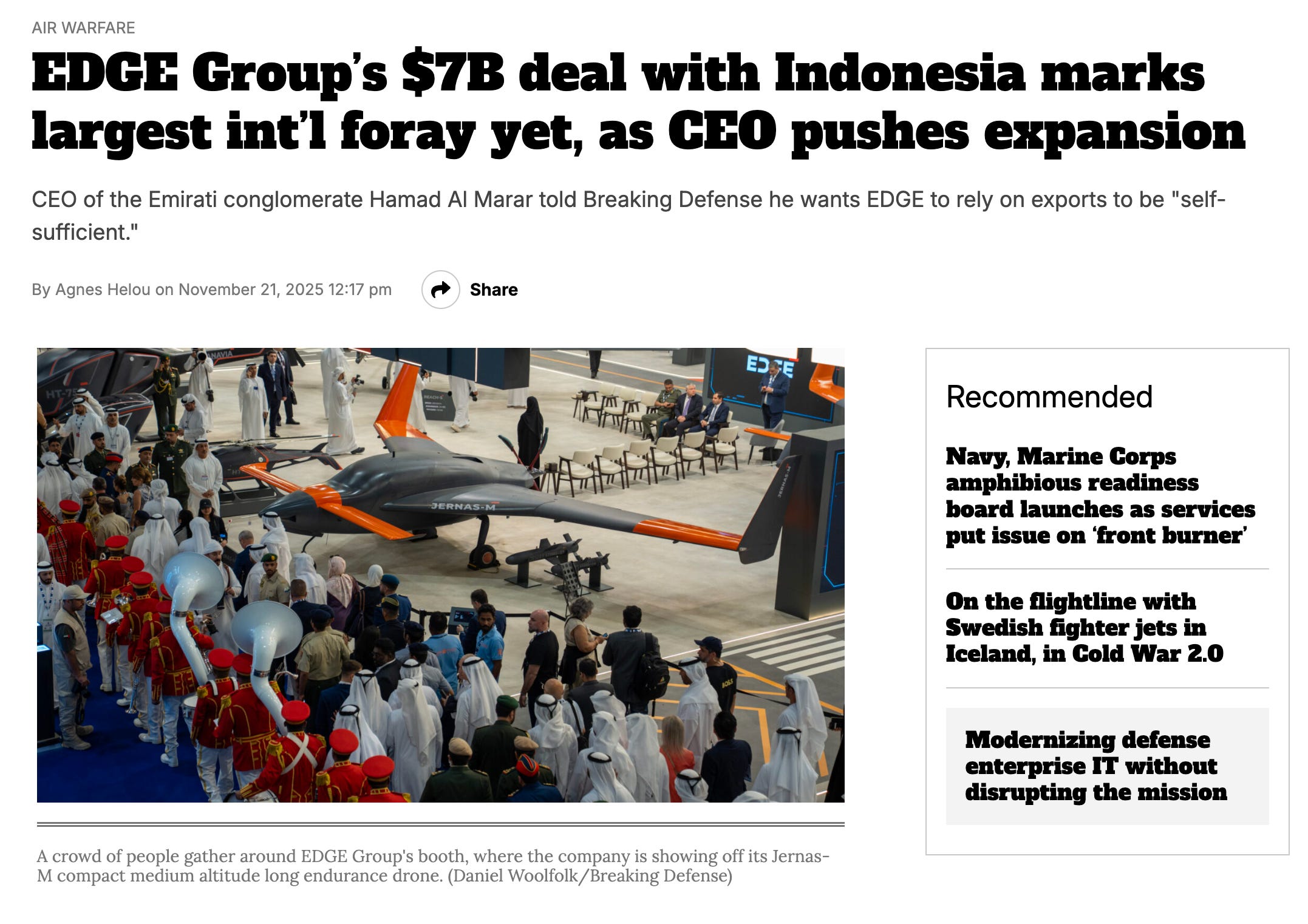
The UAE’s EDGE Group had just inked a $7 billion deal with Indonesia to modernise its armed forces over eight years: air defense missiles, infantry fighting vehicles, unmanned boats, cyber software, ammunition, all localized for domestic production. The largest international defense contract in EDGE’s history. One of the biggest arms deals in Southeast Asia in years.
If you follow tech Twitter, read TechCrunch, or scan The Information, you probably missed it. You might not have heard of EDGE Group at all.
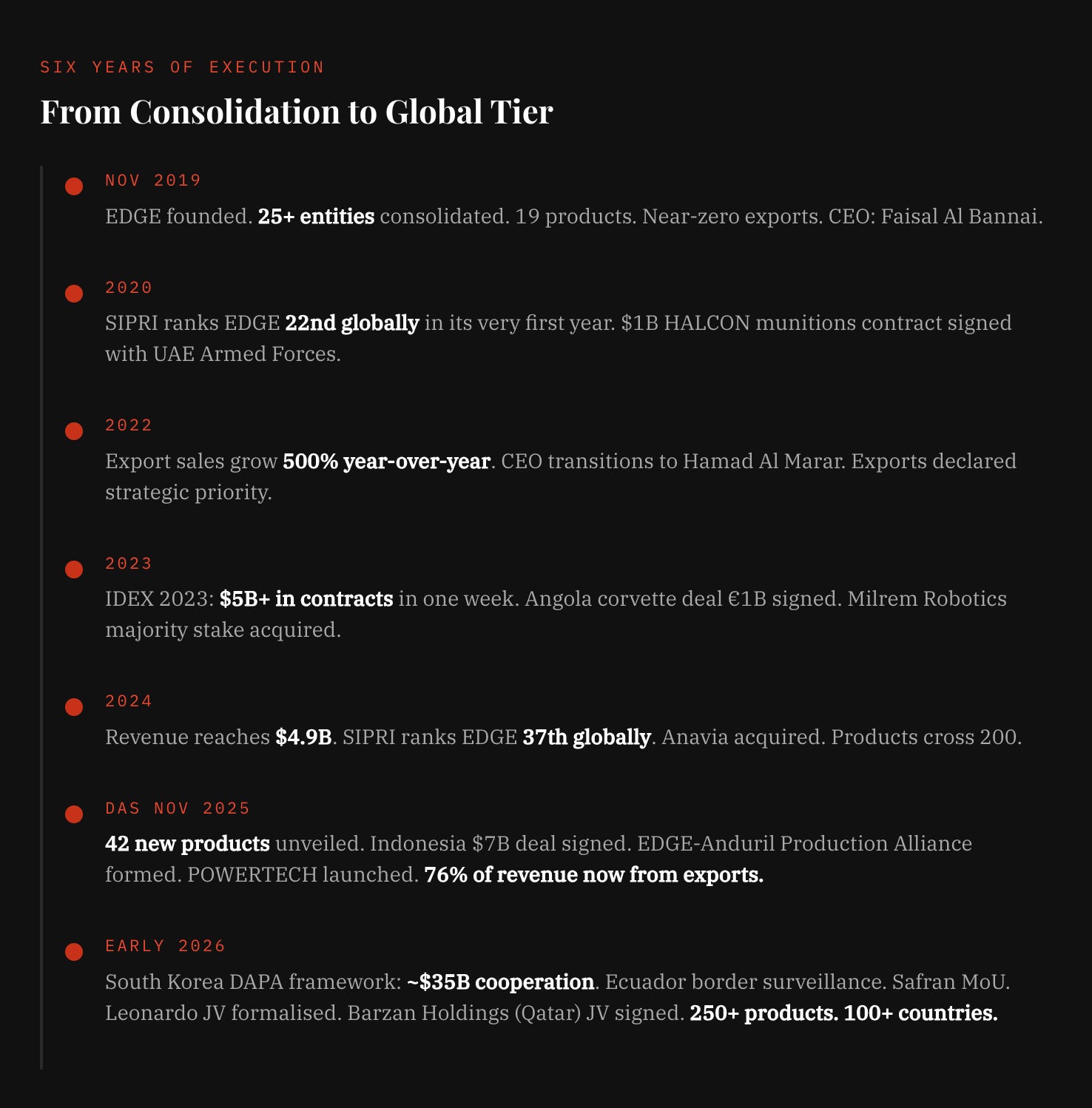
That’s the quiet part nobody says out loud: while everyone obsesses over which AI startup just raised at a $3 billion valuation, one of the most strategically important technology companies on Earth has been growing in near-total silence. In five years, EDGE went from zero to $4.9 billion in annual revenue, from a fragmented collection of state-owned entities to the 37th-largest arms producer in the world, and from 19 products to over 200.
In the last essay, we talked about how the UAE absorbed a drone and missile barrage in March 2026 and went back to business as usual. The thesis was simple: resilience is a form of power, and the UAE has built institutions designed to withstand chaos without flinching. EDGE is the embodiment of that same thesis on the defense and technology side. Methodical. Ambitious. Unapologetically strategic.
This is the story of how it happened, and why almost nobody is talking about it.
What Is EDGE, Really?
On November 5, 2019, at the Dubai Airshow, EDGE Group was officially launched by founding CEO Faisal Al Bannai, seven weeks after Iranian drones and cruise missiles struck Saudi Aramco’s Abqaiq facility and shut down half of Saudi Arabia’s oil production overnight.
The timing was not a coincidence. It was a statement.
For years, the UAE’s defense sector had been fragmented across dozens of state-owned entities under three parent organizations. So the UAE did what it does best: consolidate, streamline, and execute. EDGE absorbed over 25 defense entities into a single sovereign conglomerate, with a mandate Al Bannai described bluntly: to “disrupt an antiquated military industry generally stifled by red tape” and bring products to market faster.
Al Bannai was not a defense bureaucrat. He was the serial entrepreneur who had built Axiom Telecom into one of the Middle East’s largest mobile distributors. His instinct was to run EDGE like a startup, but as he put it, “a startup on steroids.”
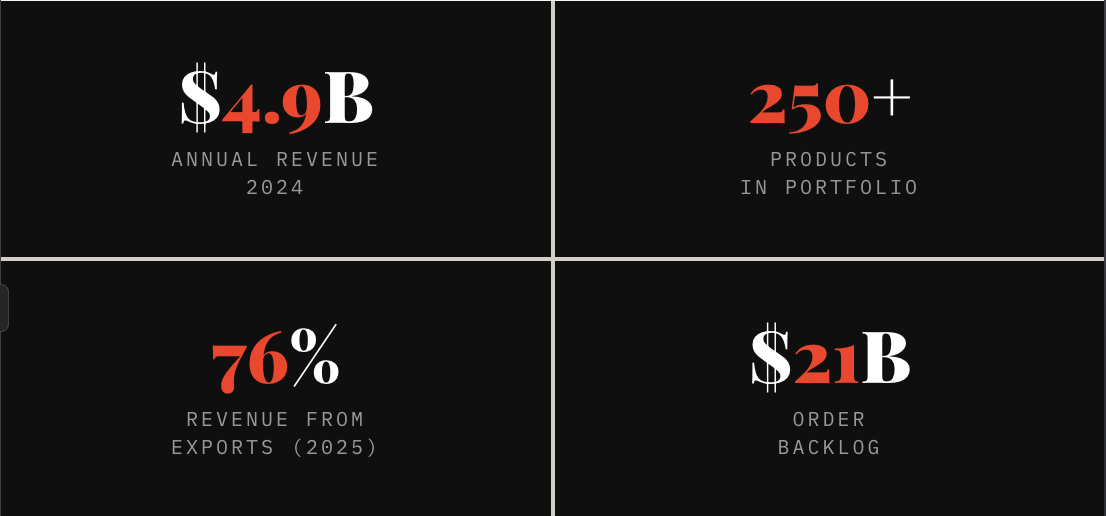
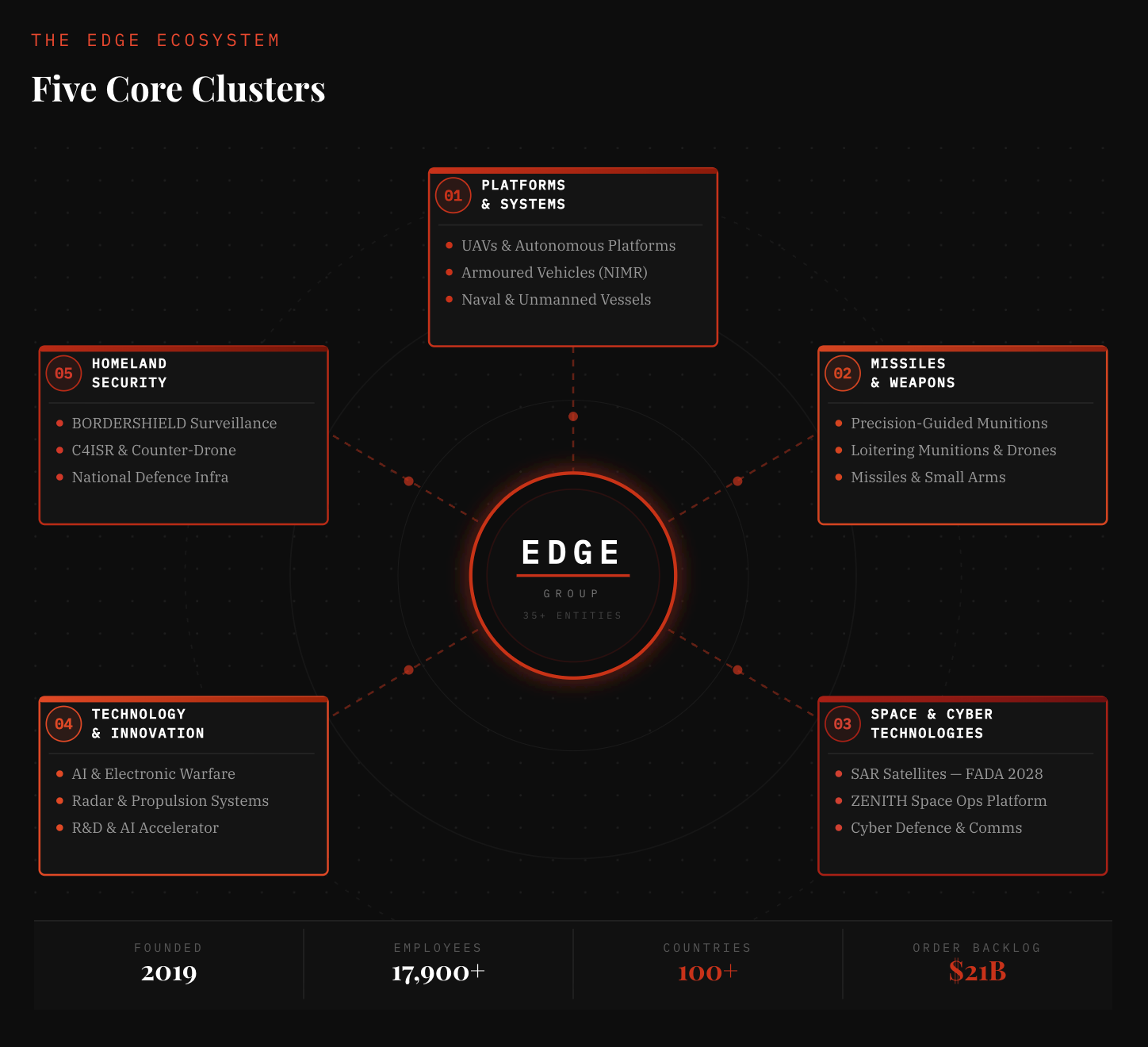
Today, EDGE consolidates more than 35 entities, employs over 17,900 people across 95 nationalities, operates in 100+ countries, and carries a $21 billion order backlog.
This is not a national champion in the traditional sense: a bloated, subsidy-dependent contractor producing legacy hardware for one customer. This is a globally competitive, export-driven, technology-first defense platform.
And it’s working.
How EDGE Quietly Became a Powerhouse
Let’s talk numbers.
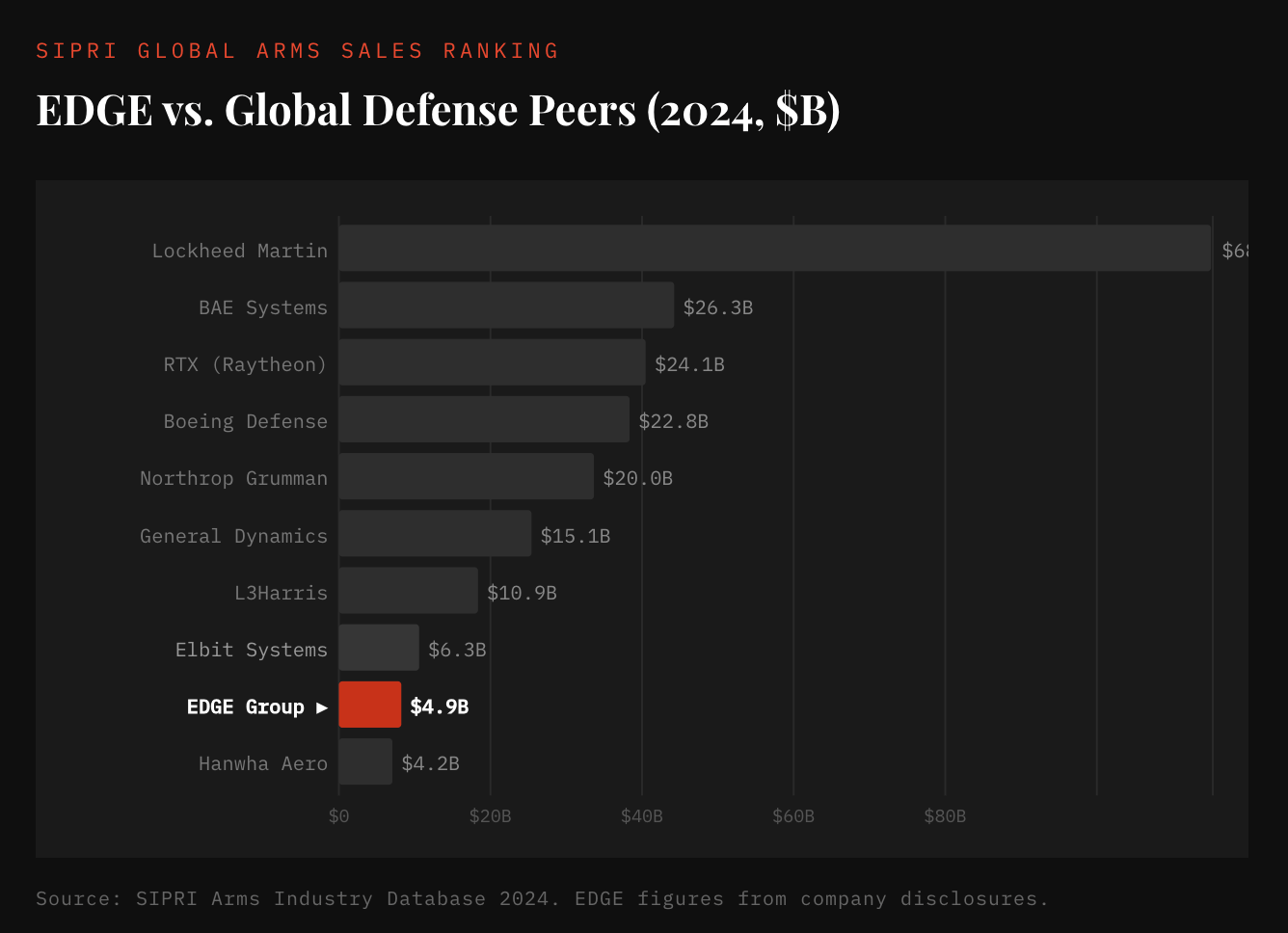
In 2024, EDGE hit $4.9 billion in annual revenue and signed $2.3 billion in new export contracts. SIPRI ranked it 37th globally among the world’s top arms producers, ahead of dozens of established European and Asian defense firms, and closing the gap with Israeli defense giant Elbit Systems ($6.3 billion). It is the only UAE company on the SIPRI Top 100. In 2022 alone, export sales grew 500% year-over-year.
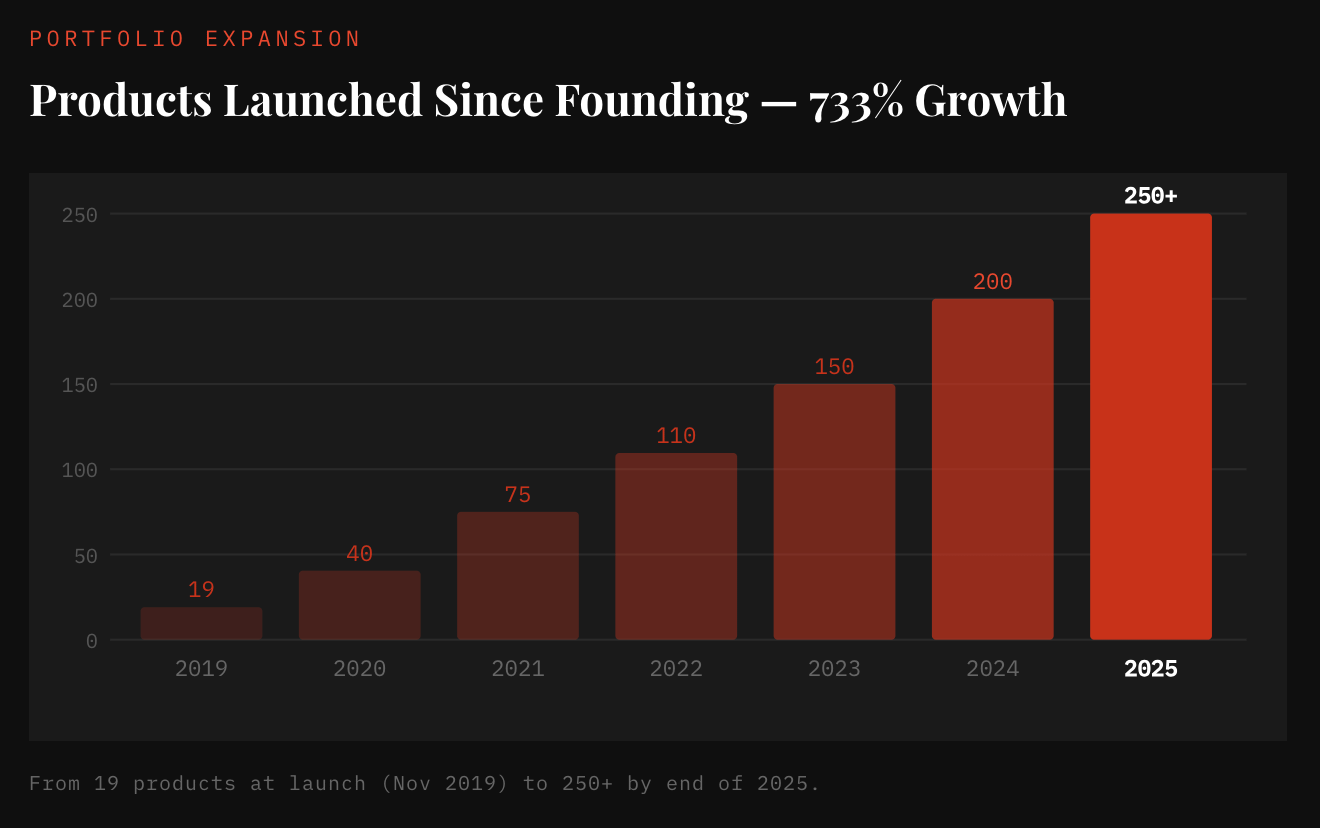
The product portfolio is what’s most striking. In 2019, EDGE had 19 products. By 2025, it had over 250, a 733% increase since launch. At IDEX 2025, it launched 46 new solutions in a single week and signed $2.9 billion in contracts, including a $1.18 billion aerial munitions deal. These aren’t legacy tanks and artillery shells.
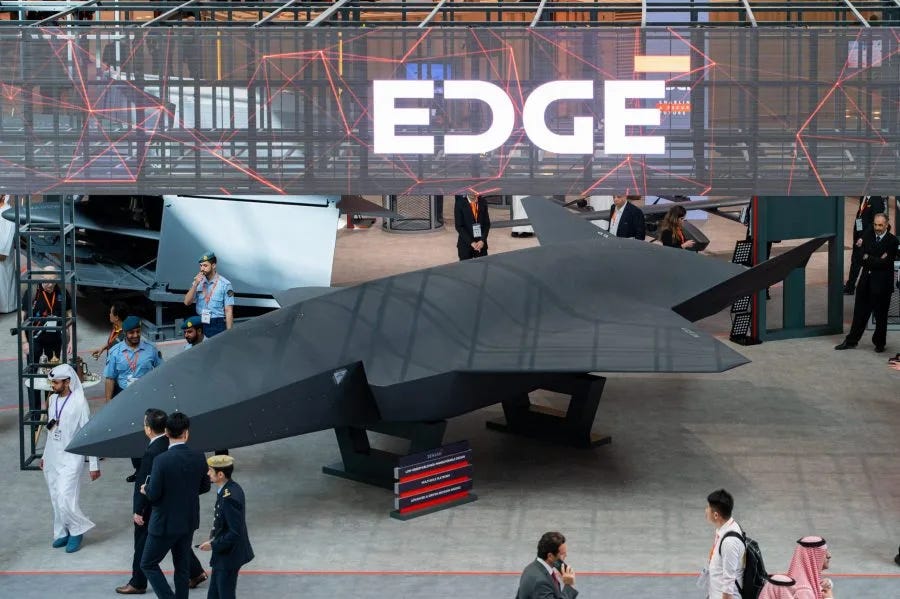
EDGE is building SKYKNIGHT, the UAE’s first domestically designed short-range air defense missile system. Desert Sting, a family of AI-guided loitering munitions. REACH-M, a medium-altitude tactical UAV for surveillance and strike. And it is now reported to be among the top three global manufacturers of precision-guided munitions.
The company is also moving into space. It launched ZENITH, a sovereign space operations platform, and created FADA, a new subsidiary planning to launch its first Synthetic Aperture Radar satellite by 2028.
To accelerate all of this, EDGE operates three Centres of Excellence, electro-optics, radar and electronic warfare, and AI, and in May 2025, launched a Group AI Accelerator to fast-track integration across its entire product line.
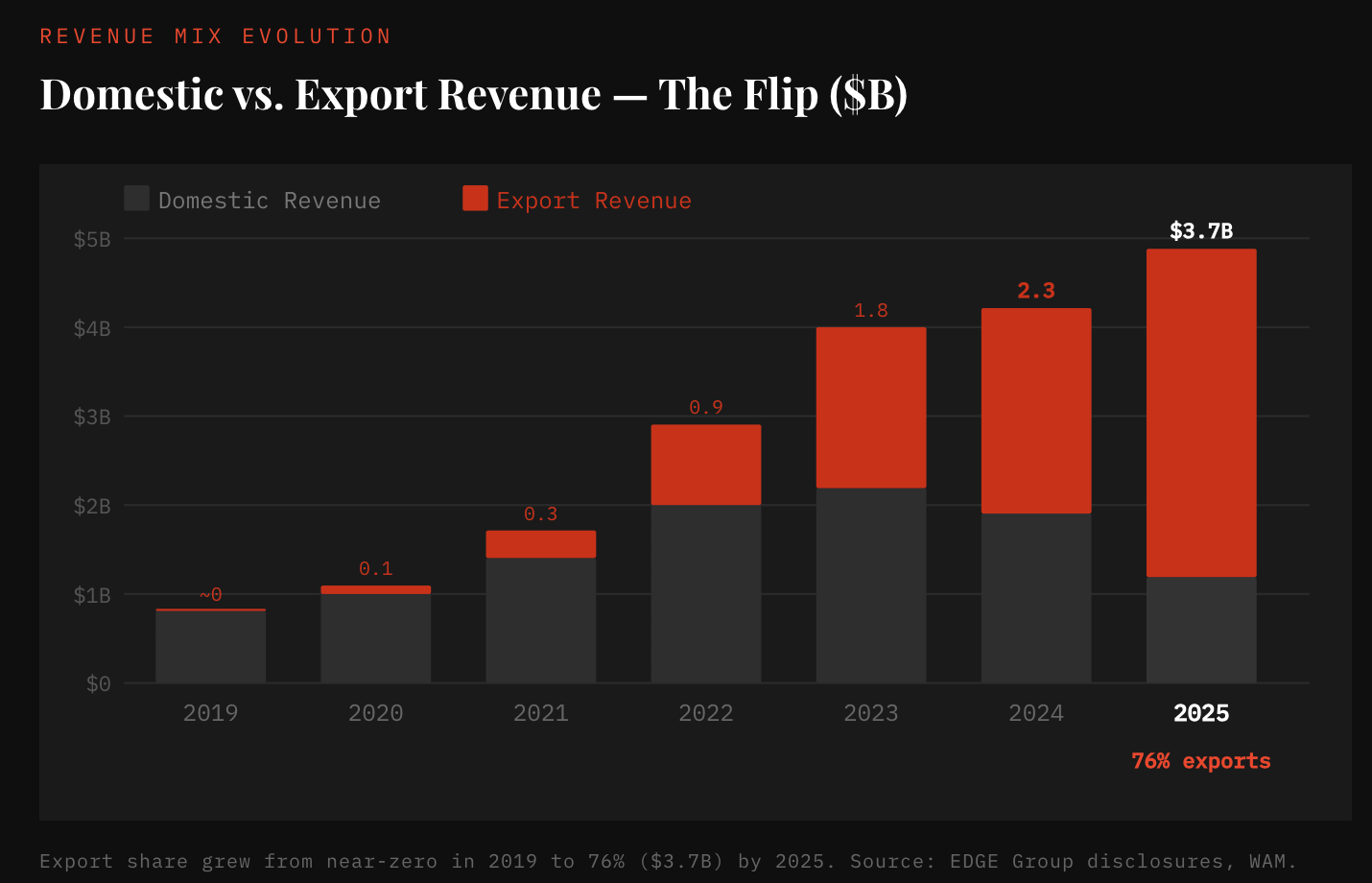
Since its founding in 2019, EDGE has been awarded contracts worth over AED 60 billion. And here’s what makes the trajectory remarkable: exports now account for 76% of total revenue, approximately $3.7 billion in 2025. The company that started as a domestic defense consolidator has become, in six years, primarily an exporter.
This is the velocity you’d expect from a venture-backed startup, except this one isn’t chasing product-market fit. It’s building sovereign capability.
The Deals That Changed the Game
Revenue tells one story. The deal sheet tells another.
Beyond Indonesia’s $7 billion, the recent contract log reads like a global expansion blueprint. The EDGE-Anduril Production Alliance has already produced its first system, the Omen VTOL, with the UAE confirming an initial order of 50 units.
“The company Peter Thiel, Palmer Luckey, and every serious defense-tech investor in America have bet on just co-produced its first operational drone with a UAE sovereign defense company. That is not a photo opportunity. That is a signal.”
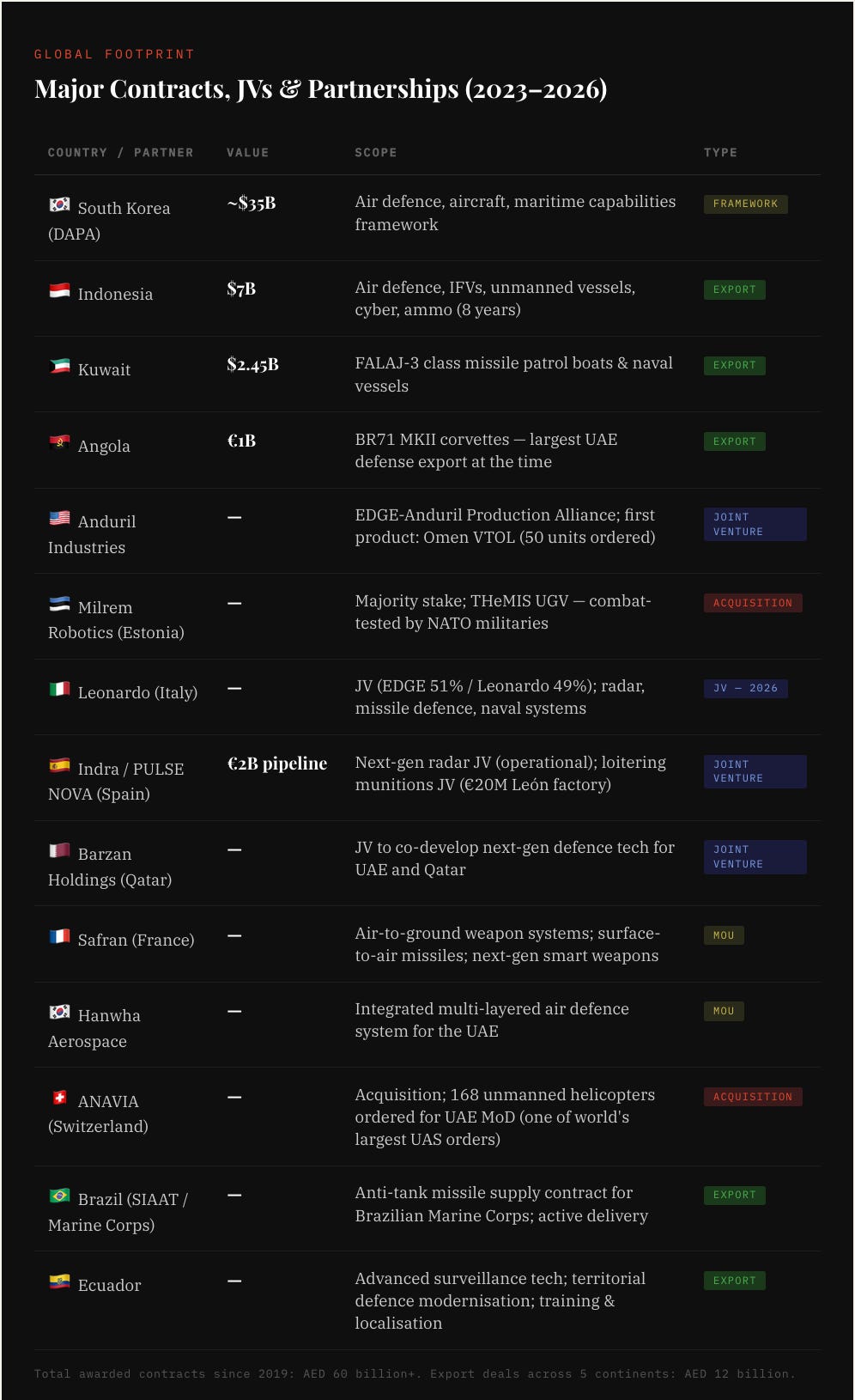
Since its founding in 2019, EDGE has been awarded contracts worth over AED 60 billion. And here's what makes the trajectory remarkable: exports now account for 76% of total revenue, approximately $3.7 billion in 2025. The company that started as a domestic defense consolidator has become, in six years, primarily an exporter.
The Leonardo JV: Europe’s Premier Defense Firm, Anchored in Abu Dhabi
If the Anduril alliance is about the future of autonomous systems, the Leonardo joint venture is about the present of complex integrated defense platforms and it may ultimately be the more consequential of the two.
Leonardo is Italy’s sovereign defense and aerospace group: a $17 billion company, majority-owned by the Italian government, ranked among the top ten global defense firms. It is, in European defense terms, what Lockheed Martin is to America.
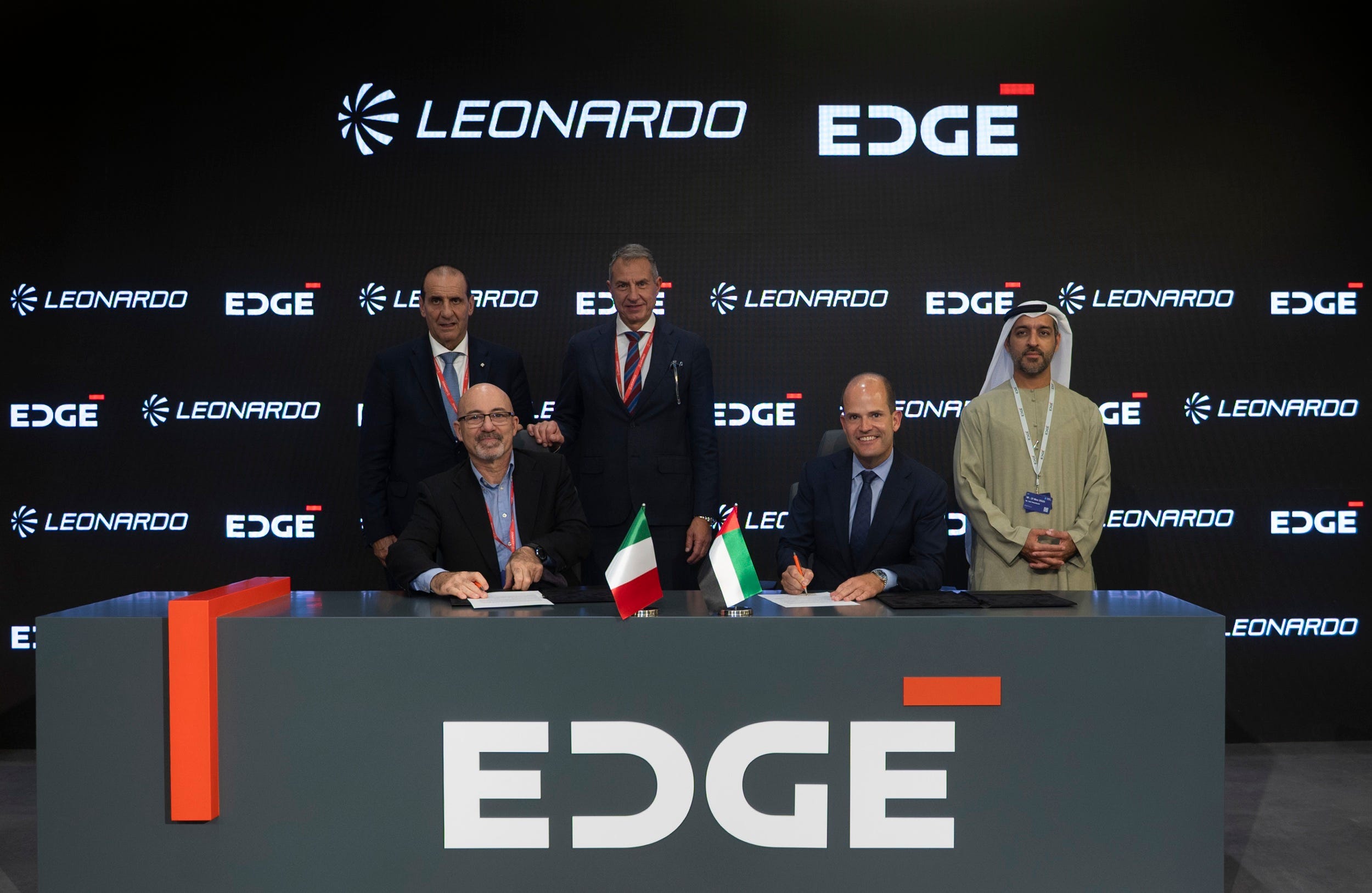
The EDGE-Leonardo JV, formalised at Dubai Airshow 2025 and set to launch in 2026, is structured with EDGE holding 51% and Leonardo 49%. All products developed will be marketed not only in the UAE but in selected international export markets, meaning this JV is not just for UAE defense modernisation. It is an export platform.
The governance structure tells the real story. EDGE a six-year-old company, holds the majority stake in a joint venture with one of Europe’s oldest and most technically capable defense firms. A skilled local Emirati workforce will be trained and embedded within the entity.
Taken together, Anduril and Leonardo represent two different vectors of the same strategy. Anduril gives EDGE access to the bleeding edge of American autonomous systems technology and the Silicon Valley defense-tech ecosystem. Leonardo gives EDGE access to deep European integration across sensors, naval systems, and missile electronics, capabilities that take decades to develop indigenously. EDGE is acquiring both simultaneously, holding majority stakes in both, and embedding both inside UAE soil.
The Unspoken Hero of UAE Strategy
Here’s what makes EDGE different from almost every other defense contractor on Earth: it’s not just a company. It’s an instrument of national strategy.
The UAE spends roughly $26 billion annually on defense (5% of GDP). EDGE exists to ensure that money doesn’t just buy foreign weapons. It builds domestic capability, creates high-skill jobs, and generates export revenue. It is a cornerstone of the UAE’s Fourth Industrial Revolution strategy, its “Make it in the Emirates” localisation initiative, and its Operation 300bn economic diversification program.
The strategic logic has three layers.
First, sovereignty. The US blocked an F-35 deal with the UAE in 2021 over Huawei concerns. The lesson was clear: when geopolitical winds shift, the country that can’t build its own systems is the country that gets left exposed.
Second, technology leadership. By investing seriously in AI, autonomy, and dual-use technology, the UAE is positioning itself as a hub for advanced R&D, not just a buyer of Western hardware.
Third, and most underappreciated: strategic autonomy for the Global South. Many countries in Southeast Asia, Africa, and Latin America want to modernize their militaries without accepting the political dependencies that come with buying American or European systems. EDGE offers something Lockheed Martin, BAE, and Raytheon cannot: sophisticated defense technology with no restrictive end-use conditions.
“Buying from the UAE does not upset East or West.”
, Hamad Al Marar, CEO, EDGE Group
This is a version of the playbook China used to become the world’s second-largest arms exporter. The UAE is running it with higher-end technology, faster execution, and a more open approach to partnerships.
Why Nobody Is Paying Attention
Open your browser. Search “defense tech 2025.” You’ll find stories about Anduril, Shield AI, Palantir. You’ll find thoughtful pieces on the Silicon Valley defense renaissance. You’ll find almost nothing about EDGE.
A few reasons why.
Western tech journalism is centered in places that assume innovation flows in one direction. The idea that a mid-sized Gulf state could build a globally competitive defense platform in six years simply doesn’t fit the dominant narrative. Then there’s the opacity of defense itself, since these companies don’t do product launches on Twitter or release user metrics.
But the deepest reason is this: EDGE doesn’t need Western media attention. Unlike a venture-backed startup that needs hype to raise its next round, EDGE has patient sovereign capital and a guaranteed domestic customer. Its primary audience is defense ministries in Jakarta, Nairobi, and Brasília; not TechCrunch readers. It has no incentive to chase coverage in ecosystems that aren’t buying what it sells.
The irony is sharp. If you care about the future of autonomous systems, AI-driven warfare, or how mid-sized powers are reshaping the global order, EDGE is one of the most important companies to watch. And almost nobody in the Western tech ecosystem is watching.
What This Means for You
If you’re a young engineer or scientist serious about defense, autonomy, or robotics: EDGE deserves to be on your radar.
The company runs the EDGE IGNITE Programme, a 15-month mentorship and training initiative for STEM graduates. It has a live AI Accelerator. And it’s building products that get tested in actual operational conditions, not just simulated ones.
For investors and strategic thinkers, the lesson is simpler: the global defense market is being reshaped, and the West is no longer the only game in town. EDGE is a signal of what’s coming: sovereign actors with patient capital and technical ambition building their own ecosystems. The next wave of important partnerships and acquisitions might not originate in Palo Alto or London.
They might originate in Abu Dhabi.
And if you’re a founder building in the UAE or GCC, especially in AI, autonomy, or dual-use tech, EDGE’s rise is proof that the ecosystem is maturing faster than most people realize. The UAE isn’t just buying innovation anymore. It’s exporting it.
The Quiet Revolution
Most companies spend their first five years proving they can exist. EDGE spent its first six years proving it deserved to be taken seriously at the global tier.
$21 billion in backlog. 250+ products. 100-country reach. 17,900 employees. A $7 billion deal with the world’s fourth most populous country. A joint venture with America’s hottest defense tech startup that has already produced its first operational drone. All of it built in six years, largely in silence.
“We are just warming up.”
, Faisal Al Bannai, Chairman, EDGE Group at Dubai Airshow 2023
That wasn’t spin. That was the sober assessment of a man who had built something real and knew how much runway remained.
The revolution is happening. It’s just happening quietly.
Most people won’t notice until it’s already over. And by then, the balance of power will have quietly shifted.
But if you’re reading this, you now know.