
“We have no competitors.”
Somewhere in the middle of most first calls I ask who else is in the market, and some version of this is what comes back. A few weeks ago a founder answered exactly that way.
While he kept talking I searched. Plain words, the ones a buyer would use. Ninety seconds, maybe less. Two companies, one of them funded last year, both selling something a customer would put in the same budget line.
I mentioned one of them.
He asked me to send him the link.
What he’d communicated was that someone who had never worked in his sector, with no domain knowledge at all, had found in ninety seconds what he claimed wasn’t there.
Whatever he said next was being read through that.
And the claim itself only has two readings, neither of them good.
Either it isn’t true, and you haven’t looked closely enough at your own market. Or it is true, in which case the more interesting question is why nobody else wants to be there. Founders offer the sentence as evidence of differentiation. It has never once functioned that way in any investor room I’ve sat in.
Founders tend to go one of two ways once a name is in front of them.
The first is vague. Looks similar, I suppose. Not sure they’re really the same thing. Non-committal, hedged, buying time. That one is obviously bad and I don’t need to explain why.
The second is fluent. Yes, I know them. Here’s what they do, here’s why it doesn’t work for this buyer, here’s the technical reason they can’t get to where we are. Sometimes it’s a genuinely excellent answer, and it’s often the best two minutes of the call.
It still leaves a mark, because it arrived after the search rather than before the question. When you tell me the difference unprompted, you’re a founder who has mapped his market. When you tell me the same thing thirty seconds after I’ve handed you a name, you’re a founder who can explain his market when pushed.
The answer might be identical. My confidence in the founder isn’t.
Sometimes I don’t have to ask, because it’s already on slide nine.
You know the slide. Four competitors down the side, six features across the top, and one miraculous row containing every checkmark. Yours.
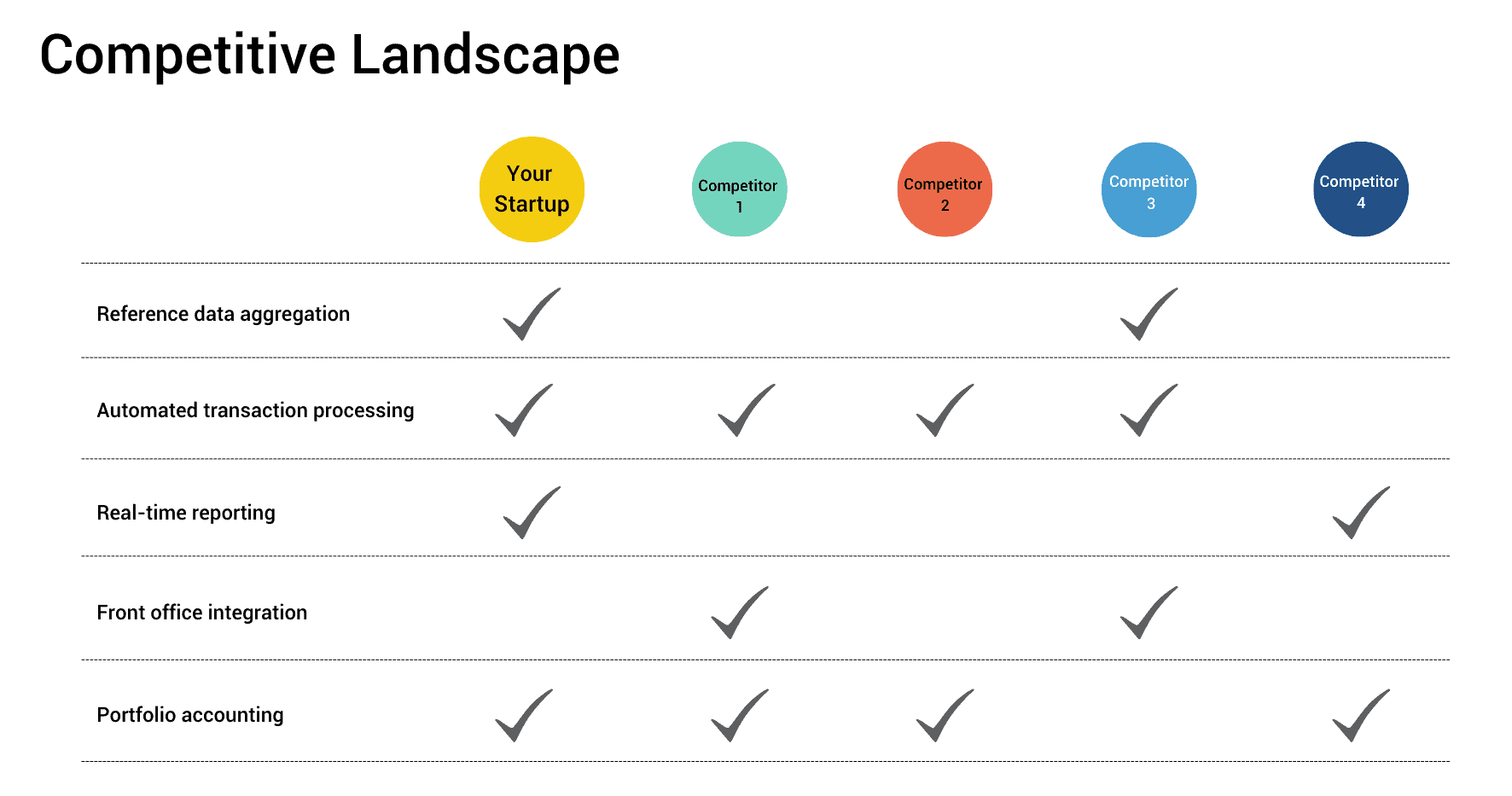
The problem isn’t the table. It’s what founders choose to put in it. Some rows are obviously live: things customers actually argue about in procurement. Then there’s usually one feature no buyer has ever mentioned, sitting conveniently in the middle of the table, where every competitor gets a cross and the founder gets a tick.
It’s often the thing the founder is proudest to have built.
So why ask a question I could answer myself with a two-minute search? Not to catch you out. That isn’t what any investor worth taking money from is doing in a first call.
In most markets your customer is already solving the problem somehow. They might be using another startup, or an incumbent. They might have built something internally, hired someone to deal with it, kept a spreadsheet alive for six years, or simply learned to tolerate the problem.
Those are all competitors. The question was never who has the same product as you. It’s what the customer does if you don’t exist.
The question does one more thing. It shows me what happens when you’re corrected by someone who knows less about your field than you do.
It’s a rehearsal for what comes later: the diligence call, the partner who found something you didn’t expect, the customer reference who names a vendor you said wasn’t relevant. If the first friendly instance goes badly, I’ve learned something about how the unfriendly ones might go.
There’s another reason to know them. Your competitors are one of the richest sources of information you have about your own market. I’ll pick that up next time.
I know naming competitors feels like a risk. Founders hedge because they think the list makes them smaller.
It doesn’t work that way from this side.
I’ve never become less interested because a founder named three credible substitutes. I have become less interested because I found one they didn’t know existed.
The answer matters less than whether I had to find it for you.
Before your next meeting
Search your own category the way a stranger would. Not the industry term. The words a customer would type when they’re frustrated and haven’t yet learned your vocabulary. Give it ten minutes.
Write down the three names that come back, and one sentence each on what a customer gets from them that they wouldn’t get from you. Not what’s worse about them. What’s genuinely there.
Then go to your competitor slide and check every row against a real conversation. If a buyer has never said that thing to you out loud, take the row out and replace it with something one of them has.
If you can’t fill three names, you haven’t found nothing. You’ve found that you’re searching in your own language.
One Question
What did your last three lost deals buy instead?
If you don’t know, that’s probably where I’d start. Tell me what you find.
Clipped
Your competitor isn’t always the company that looks most like you.
Clayton Christensen’s famous milkshake example is still one of the best explanations I’ve seen of this. The question isn’t really what products are similar? It’s what else is the customer hiring to do the same job?
Worth a few minutes, particularly before building your next competitor slide.